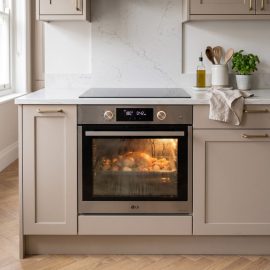
You wipe the oven out on Saturday. Sunday afternoon you put the chicken in, the fan spins up, and by the time it hits 180 there’s a thin blue haze creeping out round the door and the smoke alarm in the hall is thinking about it.
Nothing you can see is dirty. That’s the whole problem – smoke doesn’t come from the surfaces you look at. It comes from the ones you don’t, and after twenty-odd years of pulling fan ovens apart in London kitchens I’d put money on where yours is coming from before I’ve taken my coat off.
Where is the smoke coming from if the cavity is spotless?
Smoke means grease above its smoke point, somewhere in that box, getting hotter than it wants to be. Beef dripping gives up around 205°C. Butter starts complaining at 150. Your oven runs at 180 to 220 for a roast, so any fat sitting on a surface at that heat will smoke, and it doesn’t care whether you can see it.
The five walls you wipe are the coolest, cleanest part of a fan oven. Everything that smokes lives somewhere else.
The element is the first suspect and the one people never consider. In a fan oven the heating element is a circular ring behind the rear panel, wrapped round the fan, and it runs far hotter than the air in the cavity – hot enough to take fat well past its smoke point in seconds. A spot of grease on that ring smokes every single time the oven comes on, and you could scrub the cavity daily for a year without touching it.
The fat that lives where the cloth can’t
Under the base plate, too. Most fan ovens have a removable floor panel with a gap underneath it, and drips find their way down there through the vents and the edges. Nobody lifts it. Fat sits in that void, cooks a little more each time, and eventually starts smoking off a surface the owner doesn’t know exists. I lift base plates on nearly every job and there’s a fair chance of finding a year’s worth of Sunday underneath.
Grease is a liquid at oven temperature. It runs, it gets into gaps, it finds the low points and the shadows. Then it cools and sets and waits for you.
The vent is worth a mention while we’re here. Fan ovens exhaust through a duct, usually up behind the control panel or out through a slot above the door, and that duct carries every bit of fatty air the cavity produces. It furs up over the years like a flue. Grease in a vent doesn’t smoke much on its own – it’s cooler up there – but it narrows the passage, so the cavity holds onto more of its own smoke instead of clearing it, and a haze that would once have vanished now rolls out at you when you open the door.
Why does a fan oven smoke worse than a conventional one?
Because the fan turns fat into weather. A conventional oven heats by radiation and convection – the air moves lazily, fat mostly stays where it lands. A fan oven pushes air round the cavity at a good clip, and that moving air picks up vaporised fat and carries it everywhere the airflow goes. Behind the back panel. Into the vents. Up onto the roof and along the door frame.
So the mess in a fan oven is spread thin over a much bigger area than the mess in an old gas one. Thin films smoke faster than thick deposits, because there’s less mass to heat.
That’s the irony of the thing. The better your oven circulates air, the more comprehensively it distributes its own grease, and the more places it can smoke from later.
Why the fan makes a thin film worse than a thick crust
A blackened crust in the corner of the base is carbon, and carbon has already given up most of what it had to give – it’s ugly and it stains, and it smokes far less than people assume. The faint tan film the fan lays down across the roof and the rear panel is still fat, still volatile, still full of what makes smoke. So the oven that looks worse often smokes less. And the tidy-looking one, wiped weekly on every surface within arm’s reach, sends a haze up every Sunday because the film the fan put behind the panel has never once been disturbed.
Is your new oven smoking, or is the old grease burning off?
New ovens smoke, and this catches people out badly. There are protective oils and manufacturing residues on the element and the cavity steel that have to burn off, and the manual tells you to run an empty cycle at 200°C for half an hour with the window open before you cook anything. Half of everyone skips that page and gets a kitchen full of acrid smoke and a first roast that tastes faintly of factory.
That kind of smoke stops. It smells chemical rather than of food, it fades over two or three uses, and it means nothing is wrong.
The burn-off nobody runs
There’s a second version of this that I get called out to more often – a new oven in a flat where the old one was replaced and the installer didn’t clean the housing. The cabinet the oven slides into carries years of grease on its floor and sides, and the new appliance sits in the middle of it and heats it all up. Owner rings the manufacturer, insists the new oven is faulty, and it’s a spotless appliance getting warm inside a filthy hole. I’d put money on that being the answer any time someone tells me their brand-new oven smokes and the smell is of old food rather than chemicals.
Could the smoke be something other than grease?
Frequently, and the one I meet most is cleaner residue. Somebody sprays a caustic product into the cavity, wipes it down, and doesn’t rinse it properly – and caustic soda residue left in an oven fumes when it heats, with a sharp, throat-catching sting that’s nothing like food smoke. It’ll do that for several cycles until it’s finally cooked away. Anyone who’s had it will tell you it’s worse than the grease was.
The rinse is the step everyone shortcuts, and I understand why – you’ve done the hard part, the oven looks fixed, and going back over every surface with clean water and a fresh cloth three or four times feels like penance for a job already finished. Skip it and you’ll taste it. Caustic residue transfers to food, and a roast potato that’s picked up a whiff of oven cleaner is a memorable thing in the worst way.
Then there’s plastic. Bits of packaging, the odd freezer bag, a plastic clip off a chicken – they melt onto the base or drop through into the void underneath and smoke for months afterwards. Melted plastic on the base plate is the one that gets misdiagnosed as an electrical fault more than anything else, because it smells wrong and it smells serious.
The bag clip that cost two call-outs
I did a flat on Amwell Street in Clerkenwell where the owner was convinced her oven was on the verge of catching fire – smoke every use, terrible smell, two engineers had been out and shrugged. It was a plastic bread bag clip. Welded onto the underside of the base plate, where it must have slipped through a vent a year before, quietly melting a bit more every time the oven ran. Fifteen minutes with a scraper and it never smoked again. Both engineers had checked the wiring and neither had lifted the floor.
Sugar does something similar, for what it’s worth. A spill of syrup or a fruit filling that boils over caramelises, then carbonises, and burnt sugar smokes at a lower temperature than fat does and smells sweeter and sharper. People chase it round the cavity walls while it sits in the drip channel at the bottom of the door, out of the light.
When does smoke actually mean a fault?
Almost never, and I’ll say the unpopular thing plainly: stop calling an engineer about a smoking oven. You’ll pay a call-out fee for a man to stand in your kitchen, sniff, and tell you it’s dirty – and I’ve watched that happen enough times to think the trade knows full well and takes the money anyway. Smoke is a cleaning problem in the overwhelming majority of cases, and the exception isn’t subtle.
What a genuine fault smokes like
A failing element gives itself away. It blisters or splits, you’ll see a bright spot or a bulge on the ring when you look at it cold, and the smoke comes with a burnt-electrical smell and often a tripped breaker. A dead thermostat runs the oven far above its set point, and then everything smokes because the whole cavity is hotter than it should be – you’d notice your food incinerating long before you noticed the haze. Both of those are obvious. Neither of them presents as “my clean oven smells a bit on a Sunday.”
If the smoke smells of food, it’s food. That’s the entire diagnosis, and it costs nothing.
The one caveat I’d add is the extractor above the hob, which people forget is part of the same problem. A saturated grease filter and a smoke-filled kitchen go together, and if your hood hasn’t had its filters through the dishwasher in a year then some of what you’re breathing on a Sunday never came out of the oven at all. It came out of the ceiling.
I’d put money on this being the shortest useful test in the trade: run the empty oven at 200 for twenty minutes and stand there with your nose near the vent. Chemical means residue or a new appliance. Burnt toast and roast dinners means fat, somewhere behind a panel, and it means someone’s taking that panel off.
Pulled a fan out in Herne Hill last week that was so caked the blades had gone from silver to the colour of gravy, and the cavity it sat behind was spotless enough to eat off.